
From: Muhammad Faizan Raza and Lemisa Selimi
You have so many books you want to read, do you not? As humans have always been inclined to making life easier and easier, we have a solution for that too, you do not need to read all your ever growing list of books in order to know the best and most worthy of reading books. Through computational text-analysis, you can become a far more efficient reader and even save your time for other things you enjoy instead of just going through books and at the end find out it was not worth it. You can get the main idea and much more about a book through the help of analysis and interpretive powers of computers. Tools such as Voyant are great at that. You can get word clouds, word frequencies, correlations, mandala, and many more.
Books
Eckhart
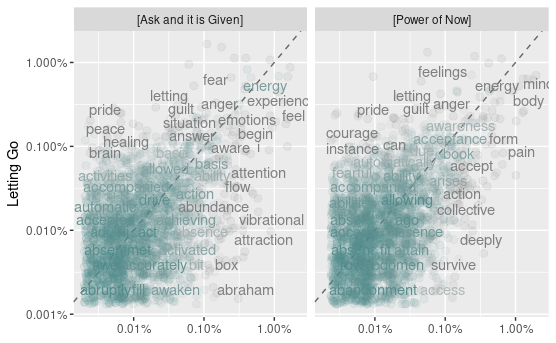
- Most frequent words in “The Power of Now”: mind (441); body (325); pain (260); life (260); time (232)
- Most frequent words in “A New Earth”: ego (417); life (271); form (244); consciousness (232); people (229)
David
- Most frequent words in “Letting Go”: feelings (401); love (332); self (324); fear (324); life (304)
- Most frequent words in “Transcending Levels of Consciousness: consciousness (434); spiritual (432); level (418); self (412); ego (277)
Esther Hicks
- Most frequent words in “Ask and It is Given”: feel (480); want (465); desire (354); experience (324); process (309)
- Most frequent words in “Astonishing Power of Emotions”: feel (420); thoughts (255); want (251); life (249)
The most common words revolve around the individual, their mind and experience, such as feeling or desire, pain, or thoughts. Ego and Life seem common words in Eckhart’s and David’s books, and Life is seen in the books of all these authors.
Most of these books are within the genre of self-help books and one of the key terms or themes they focus on is enlightenment. Some others include: consciousness, personal growth, feeling, change, presence, vibration, etc. For example, from our research, the power of now seems to be about understanding what the mind is and transcending it through being present, connecting with one’s body, perceptions, and awareness that is beyond all of one’s conditioning. Whereas Letting Go seems to be about reaching ecstasy, peace, and enlightenment through surrendering. These books are very renowned, some of them being best-sellers, because of the impact they have on their readers. Besides writing books, these authors are known for guiding people, giving speeches or inspiring talks, organizing workshops, etc.
What we knew before doing the text analysis of these books?
- About the books of David Hawkins, they are scientific and explanatory as much as they are mystical. I think he has such a great ability to explain enigmatic matters such as higher levels of consciousness. He talks about transcendence and letting go.
- Eckhart Tolle has a very simple language and yet is able to convey so much. His central idea revolves around presence and rising above thinking.
- Esther Hicks has a very assertive and positive way of speaking. The main theme is the law of Attraction.
Wordclouds
Eckhart
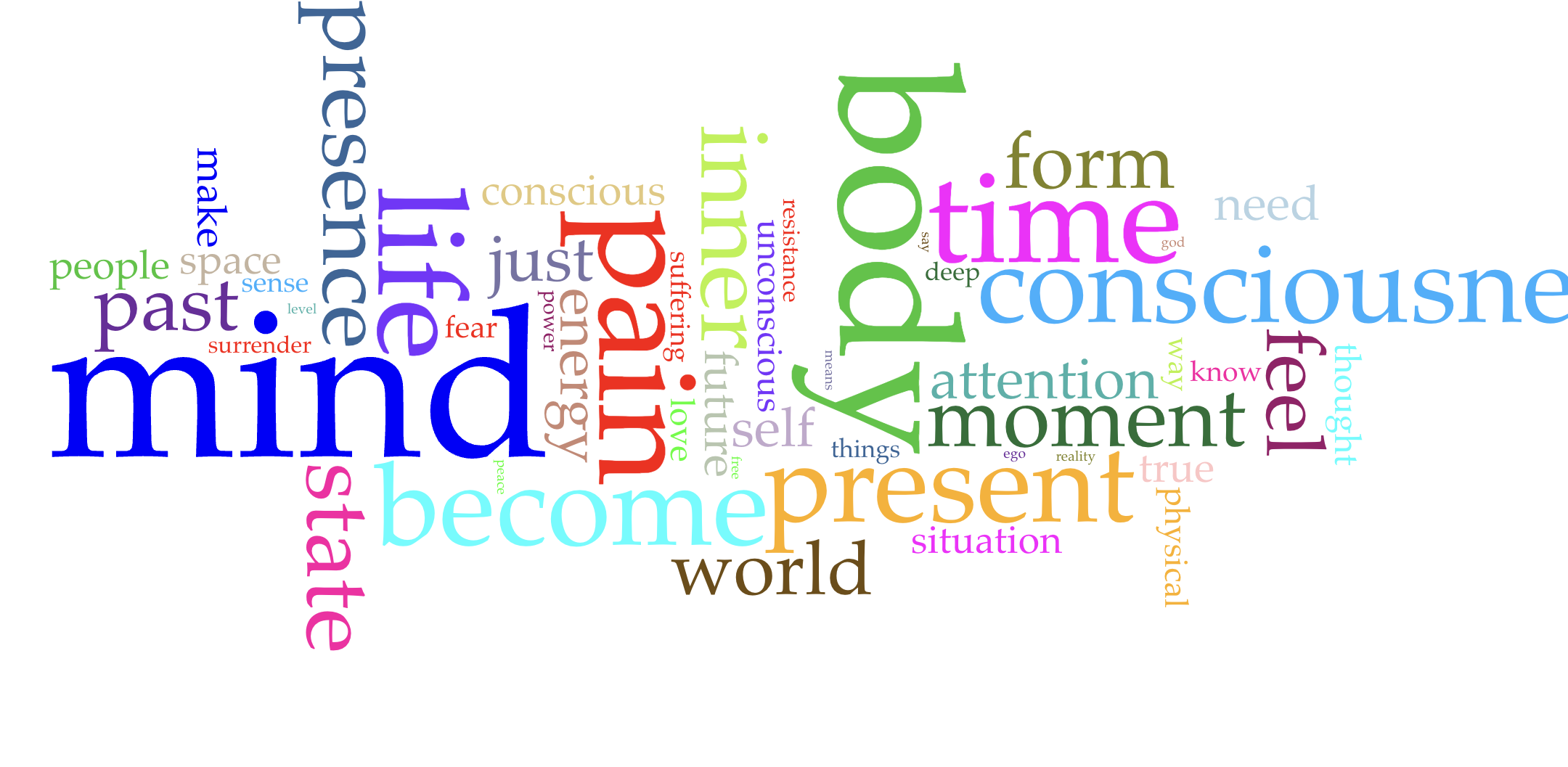
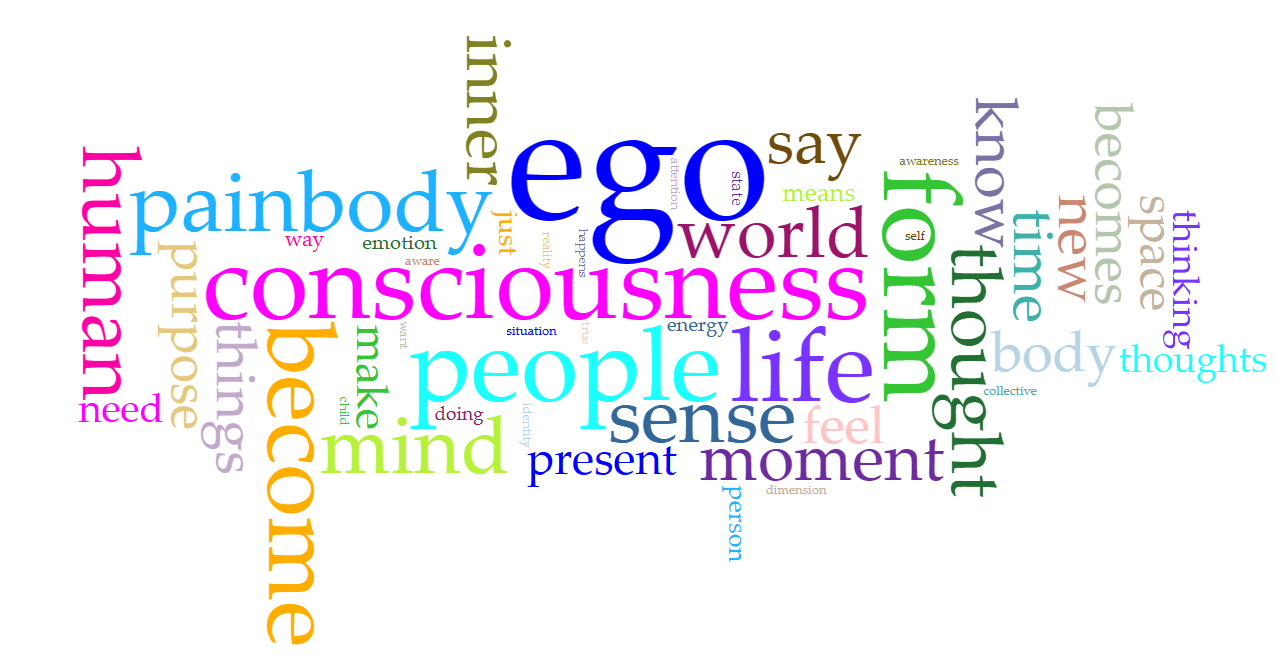
The biggest words shown in the word clouds correlate with the titles as shown in “Consciousness” being the biggest in the book transcending levels of consciousness, and “surrender”, “negative”, “feelings” among the biggest in Letting go, which does not only match with the title but also the core of the book which is achieving liberation through the mechanism of surrender. However, most of the words are similar (energy, love, spiritual, life), with the only difference being their frequency of usage in the books, which shows that although the author might be explaining different things in these 2 books, his philosophy is the same. The word self is used a lot in both.
David
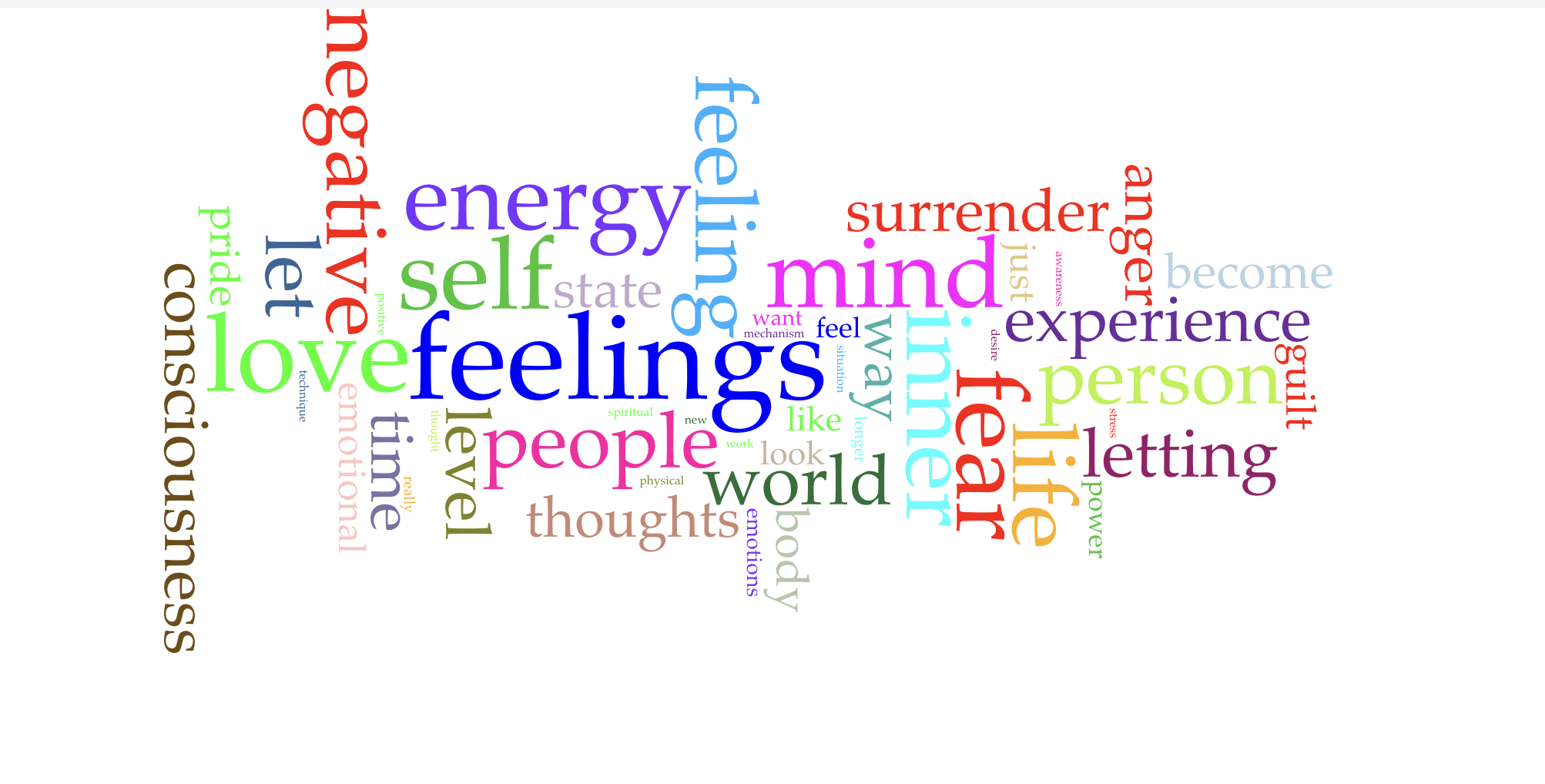
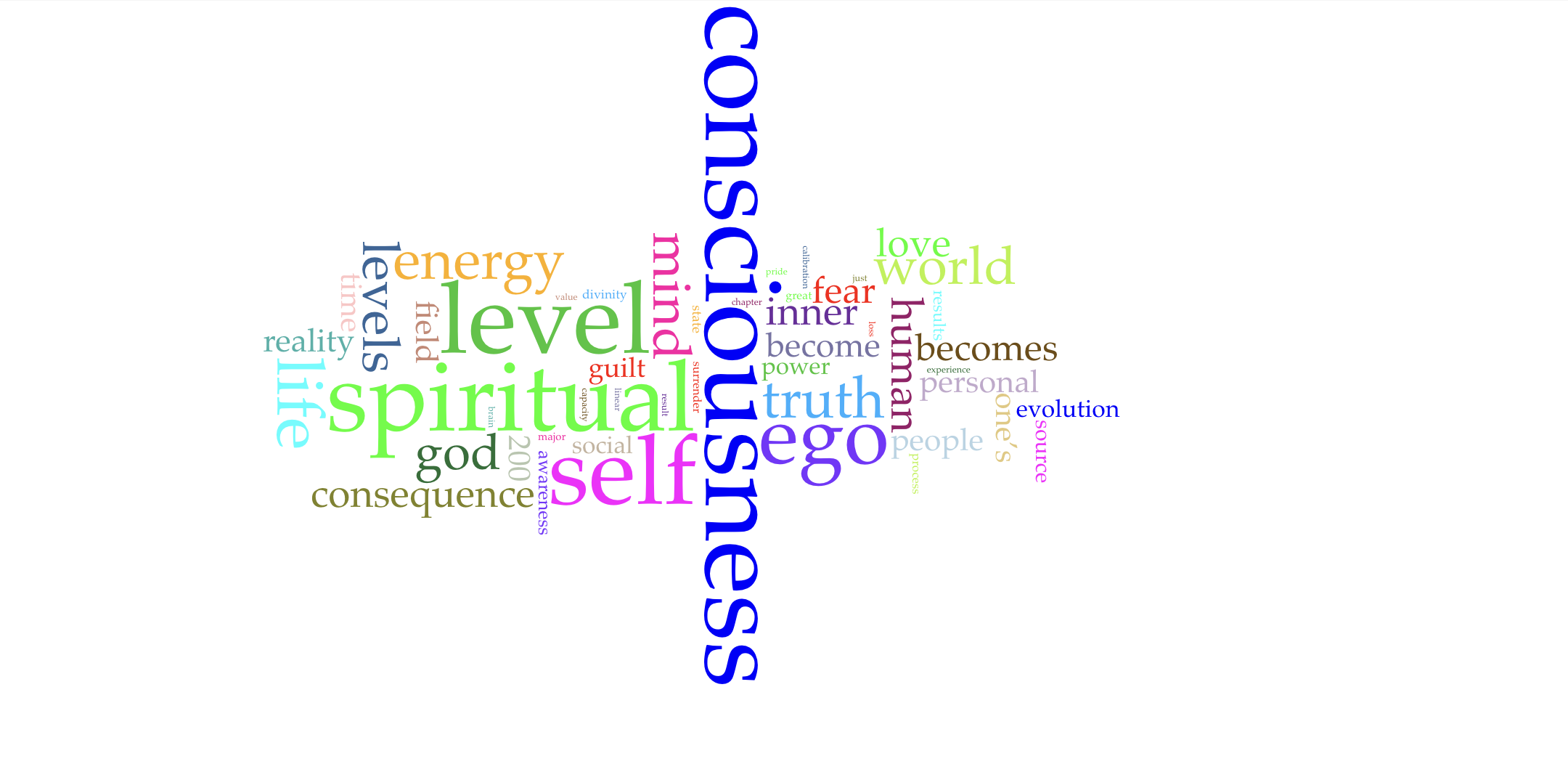
Again, here too, many words between the two books are similar (present, moment, body, and consciousness the most). However, the Power of Now seems to be more central to the individual with the main idea revolving around mind, body, attention, and inner, whereas in “A new earth”, this main idea seems to be expanded in the larger scale of humanity with the words being: people, ego, human, purpose, painbody, etc.
Esther Hicks
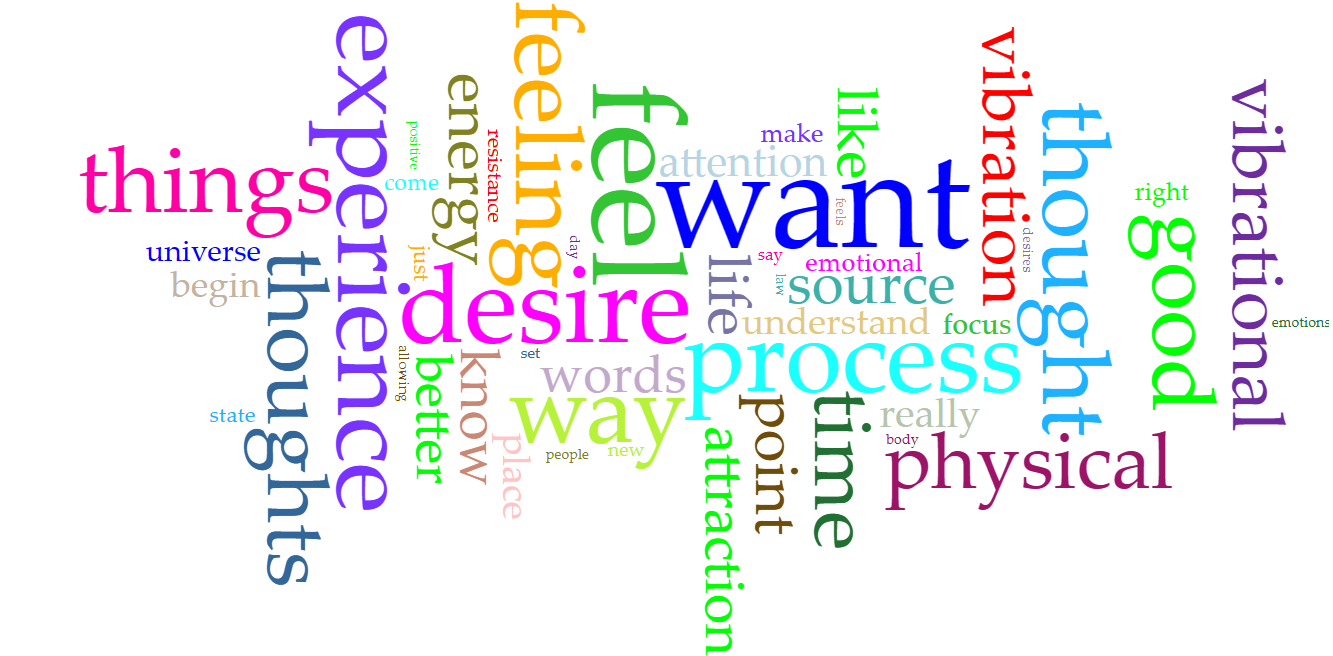
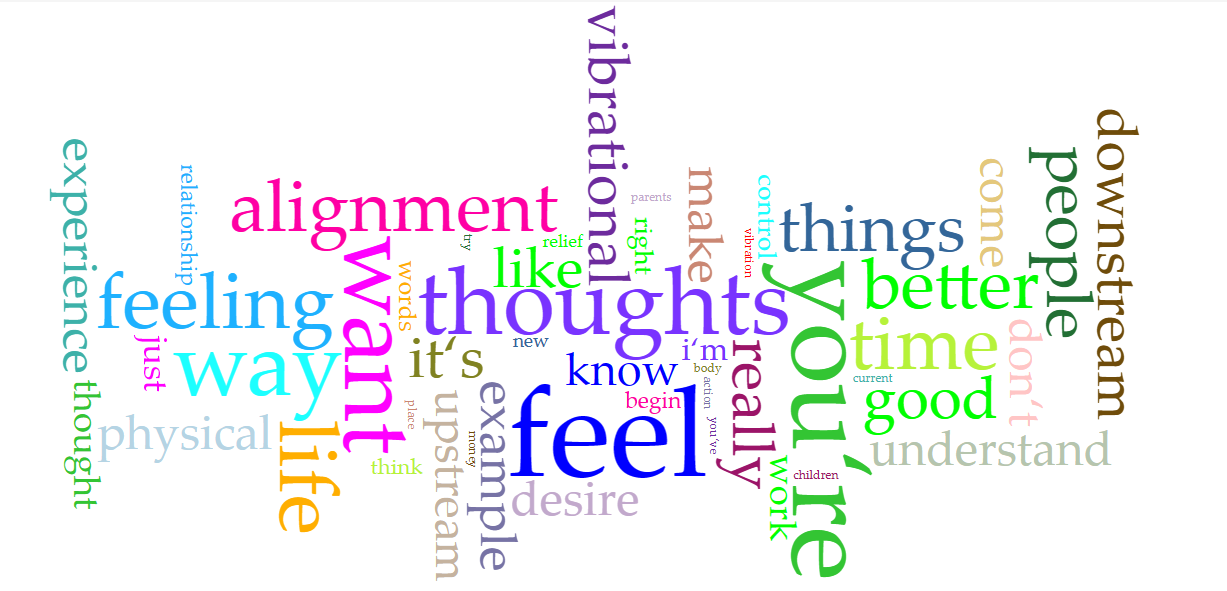
These two books seem to have a similar theme too, with the common words being: want, feeling, thought, experience, good, etc. A noticeable difference though is that in the second book, “The Astonishing Power of Emotions”, among the main words are “upstream” and “downstream”. So, we went to “context” tool and searched for the word upstream, where we got the number of its usage in the corpus (124) and we had the chance to find all the places it was used. This way we were able to quicly understand what that meant by clicking on the paragraphs. “Being slender matches the emotion of happiness. (downstream) Being fat matches the emotion of unhappiness. (upstream) Having enough to eat matches the emotion of happiness. (downstream) Not having enough to eat matches the emotion of un-happiness. (upstream) The key to creating everything that you desire is to find a way to turn to the better-feeling, downstream thoughts, even when the current situation does not evoke it from you, and to use your willpower to focus your thoughts in the direction of your desire and who-you-really-are, rather than using your willpower to try to produce action against the Current.”. And then, Hicks goes on to describe how to turn from upstream to downstream. This matches with the title of the book because the technique is identifying low feelings and using these to reach some better feeling vibrations…
Word Frequency Graph
How much do our findings match what we knew before
Philosophies: Eckhart: “Suffering comes from the mind and unconscious identification with it. Presence is the way out of the mind.” David: “The way to transcend consciousness is to allow and experience the lower levels fully.” Esther: “All that matters is how you feel. If you feel good, the law of attraction will always respond in the way you’d like to.” Through the tool “context”, Voyant allows us to see some phrases or groups of words and then click on them to read a paragraph which is a wonderful way to identify things we like in one book and then read those pieces or even read the entire book. I.e. we can see words like mechanism and technique are mentions many times in the books of Hawkins and when we click on them, we find out sentences like: “One surprising observation about the mechanism of letting go is that major changes can take place very rapidly. Lifetime patterns can suddenly disappear, and long-standing inhibitions can be let go of in a matter of minutes, hours, or days. Rapid changes are accompanied by an increased aliveness. The life energy set free by the letting go of negativity now flows into positive attitudes, thoughts, and feelings, with a progressive increase of personal power.”, which confirm his philosophy described above.
The Value of Digital Humanities
In this course, we have discussed the value of technology and humanities, and have kept putting that into practice throughout our technical pracices, questions, dicussions & reflections, etc. This is very important, when it comes to analyzing and understanding corpora with more efficiency as well. Drucker, for example, in his book emphasizes how to value one word multiple factors come into play, not just the number it appears in a text. One of them is the comparison or judging the number one word is used in relation to how often the other words are used. (Drucker, 112)
“Patterns of changes in vocabulary, nomenclature, terminology, moods, themes, and a nearly inexhaustible number of other topics can be detected using distant reading techniques, and larger social and cultural questions can be asked about what has been included in and left out of traditional studies of literary and historical materials.” (Drucker, 113). This shows the great value that technology plays when it comes to analysing large data, which humans just cannot. While digital tools seem like a superpower, they have their limitations too. An interesting example of that would be a study of mood words in some novels of 20th century to see if there was any correlation between the tone of novels and events like wars. It turned out that the “sadness” score was greatest during the years of the Second World War but, oddly, “joy” was highest during the period of the First World War. (Drucker, 114). Distant reading often points out areas where close reading will be of value. (Drucker, 115). “If computational text analysis is to move beyond its current status as a narrow specialization and join the broader discourse of the humanities, it must find ways to occupy a useful space in the landscape of interpretative inquiry.” (Ramsey.) We think as well that no matter how much technology advances, there will always be the need for humans or humanities, the questioning and contemplation . After all, what is the use of advancement if it is not used for our good, our planet’s good, or just for a good cause?
We thank you for reading!
Bibliography: Ramsey, “In Praise of Pattern,” TEXT Technology 14.2(2005). Drucker, The Digital Humanities Coursebook (Routledge, 2021).